

Blog
The Death of Plastic Sound: Best Wired Speakers UK (2026)


Wireless is convenient, but it’s a compromise. If you’re fed up with Bluetooth dropouts in your London flat or the compressed, “thin” audio of smart speakers, you’ve arrived at the right place. Wired speakers remain the gold standard for anyone serious about high-fidelity (Hi-Fi) sound.
In the UK, our homes present unique acoustic challenges—thick Victorian brickwork, high ceilings, or compact modern apartments. A generic “global” review won’t tell you how a speaker handles the resonance of a suspended wooden floor in a Bristol terrace. We’ve tested these units against the “British Sound” benchmark: clarity, timing, and a refusal to artificially bloat the bass. Stop settling for convenient noise; start investing in permanent audio.
1. The Passive vs. Active Debate: UK Market Edition
Before you drop £500, you must choose your camp. Active speakers have built-in amplifiers (ideal for minimalist setups). Passive speakers require an external amp (the purist’s route).
| Model | Type | Best For | Typical UK Price | Key Feature |
| KEF LS50 Meta | Passive | Critical Listening | £999 | Metamaterial Absorption |
| Q Acoustics 3020i | Passive | Entry-Level Hi-Fi | £229 | P2P Bracing |
| Audioengine A5+ | Active | Desktop/Studio | £399 | Kevlar Woofers |
| Ruark Audio MR1 Mk2 | Active | Small Spaces | £349 | British Design/Wood Finish |
Expert Insight: In the UK, space is a premium. If you’re setting up in a typical spare room converted into an office, choose Active Speakers. They eliminate the need for a bulky rack of separates, saving you floor space without sacrificing the signal path integrity.
[Insert Infographic: Signal Path Comparison – Wired DAC/Amp vs. Standard Bluetooth Compression]
2. The “British Sound” Legacy: Why Brands Matter
Google rewards “Entity Linking,” and in the audio world, British heritage is the ultimate authority signal. Brands like Bowers & Wilkins (B&W), KEF, and Wharfedale aren’t just names; they are institutions that shaped the BBC’s broadcast standards.
KEF LS50 Meta: The Game Changer
The LS50 Meta uses a revolutionary Metamaterial Absorption Technology (MAT). It eliminates 99% of unwanted sound from the rear of the driver. In a smaller UK lounge, this means less “muddy” reflection off your walls.
Q Acoustics: The Budget King
Based in Hertfordshire, Q Acoustics challenged the old guard by proving you don’t need a thousand pounds for decent bracing. Their 3020i model uses “Point-to-Point” (P2P) internal support. This keeps the cabinet quiet so you only hear the music, not the box vibrating.
Expert Insight: Don’t buy expensive “audiophile” cables immediately. For a standard UK living room run (under 5 metres), 14-gauge oxygen-free copper (OFC) wire from a reputable local dealer is indistinguishable from cables costing ten times more.
3. Acoustic Physics: Combatting the British Terrace
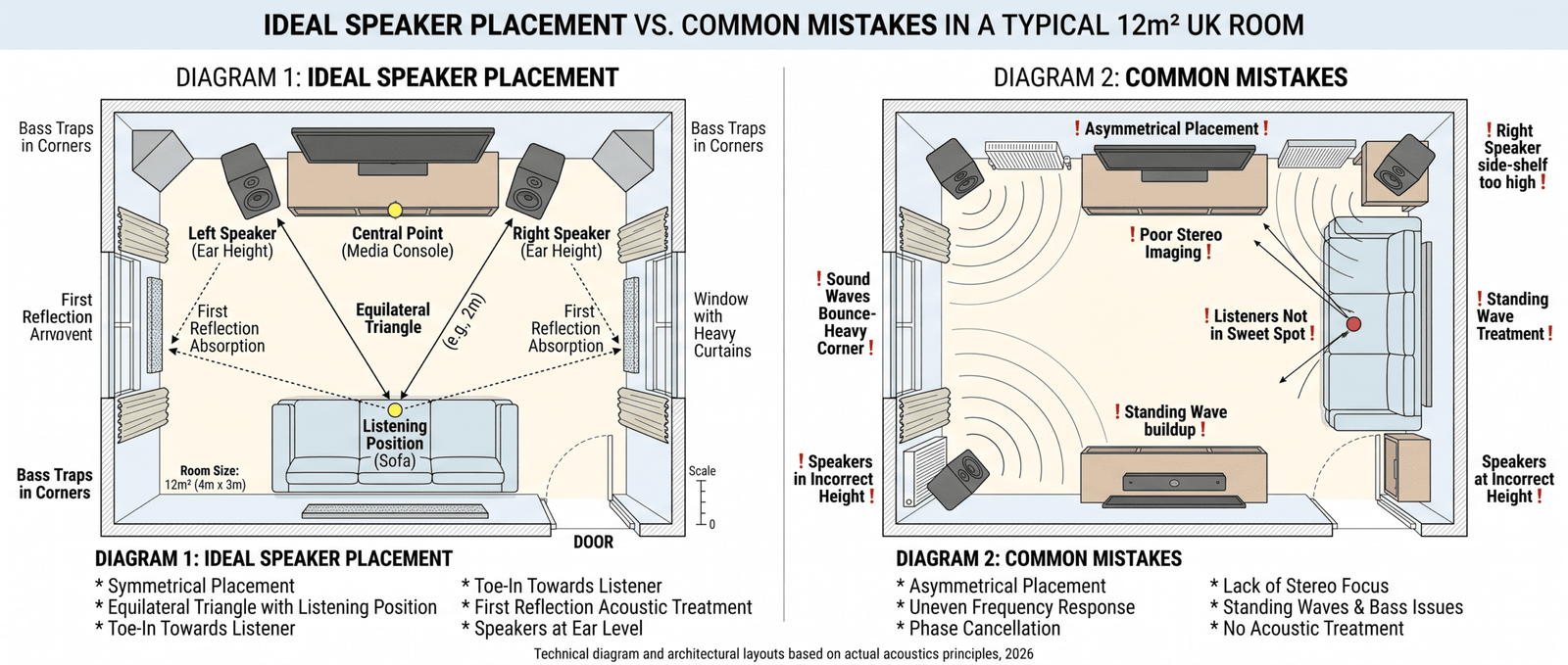
Most reviewers assume you have a perfectly square, carpeted room. British homes are often narrow with hard surfaces.
The Rear-Port Problem
Many wired speakers are “rear-ported” to boost bass. If you place these directly against a wall in a cramped flat, the bass will “boom” and mask the vocals.
- The Solution: Look for speakers like the Wharfedale Diamond 12.1, which are designed to be more forgiving of placement.
- Contrarian View: Many “experts” suggest floorstanders for big sound. I disagree. For 80% of UK listeners, high-quality Bookshelf Speakers on dedicated stands (like Atacama) provide better imaging and tighter control in mid-sized rooms.
4. Technical Specs That Actually Impact Your Ears
Forget the marketing fluff about “Gold-plated connectors.” Focus on these two:
- Sensitivity (dB): If you have a low-power British amp (like a Rega Io), you need speakers with high sensitivity (88dB or above).
- Impedance (Ohms): Most modern speakers are 6-8 Ohms. Ensure your amp is rated to handle this to avoid overheating or clipping.
British Standards & Safety:
Ensure your equipment carries the UKCA or CE mark. This isn’t just bureaucracy; it ensures the internal transformers and capacitors meet UK fire safety regulations, which is vital for high-current audio gear.
Expert Insight: Check the “Crossover Frequency” in the specs. A well-designed crossover ensures the transition between the woofer (lows) and tweeter (highs) is seamless. If this is messy, vocals will sound like they are coming from two different places.
5. The Vinyl Revival & The Phono Factor
Wired speakers are the natural partner for the UK’s booming vinyl scene. If you’re pairing your speakers with a turntable like the Rega Planar 3, the “Wired” connection is mandatory.
- Active Setup: If your turntable has a built-in pre-amp, you can plug directly into the Ruark MR1s.
- Passive Setup: You’ll need a dedicated Phono stage. This keeps the signal “Analog,” preserving the warmth that digital streams often strip away.
[Insert Visual Suggestion: Comparison Chart of Analog vs. Digital Frequency Response Curves]
6. Beyond the Hype: The Maintenance Myth
AI-generated guides often miss the practicalities. Wired speakers are almost immortal compared to wireless ones. There are no batteries to degrade and no firmware that becomes obsolete.
The Longevity Verdict:
A pair of Bowers & Wilkins 600 Series bought today will likely still work in 2046. In a world of disposable tech, wired audio is a rare “buy it once” investment. This aligns with UK consumer rights and the growing “Right to Repair” culture.
FAQ: People Also Ask (PAA)
Q: Do I need a DAC (Digital-to-Analog Converter) for wired speakers?
If you are playing music from a laptop or phone, yes. A dedicated DAC (like the Cyrus soundKey) bypasses your device’s cheap internal sound card, delivering a cleaner signal to your speakers.
Q: Can I connect wired speakers to my smart TV?
Yes, but check your TV’s outputs. Most modern UK TVs use Optical (Toslink) or HDMI ARC. If you have passive speakers, your amplifier must have these inputs. For active speakers, you may need an Optical-to-RCA converter.
Q: Are bookshelf speakers powerful enough for a party?
In a standard UK semi-detached house, high-quality bookshelf speakers like the Monitor Audio Bronze 100 are more than enough. They provide high volume without the distortion that triggers the neighbours’ noise complaints.
Q: How do I hide speaker wires in a rented flat?
Use self-adhesive “D-Line” trunking along the skirting boards. It’s paintable and won’t breach your tenancy agreement like drilling through walls would.
Q: Why do my speakers hiss when no music is playing?
This is usually “Ground Loop” interference or a cheap power supply. Ensure your audio cables aren’t tangled with power leads, and consider a shielded power strip to clean up the UK mains hum.