

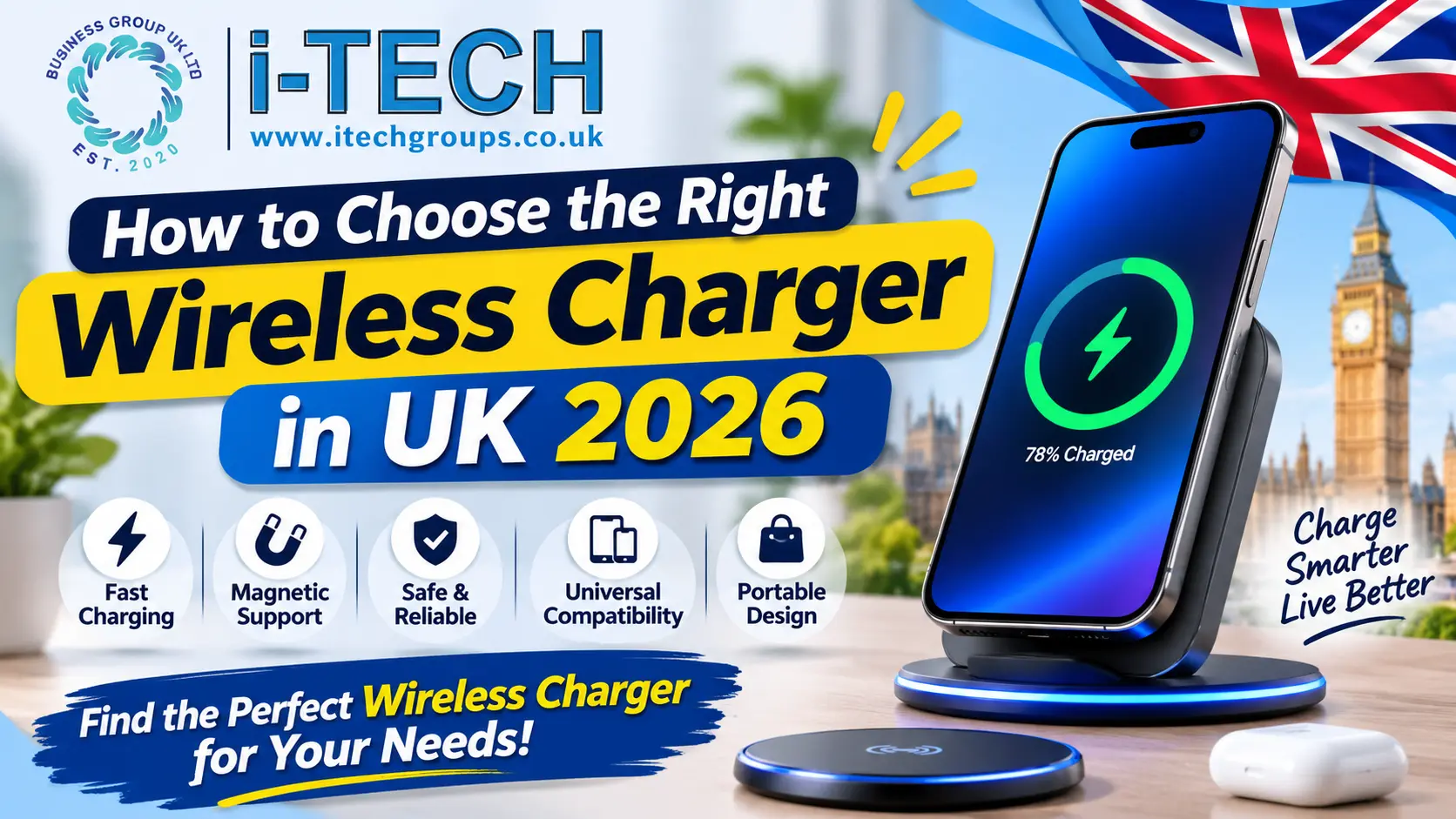
Choosing the right wireless charger can make charging your smartphone more convenient and help keep your desk, bedside table or workspace organised. With different charging standards, power ratings and designs available, finding a suitable wireless phone charger in the UK requires more than simply choosing the cheapest option.
Whether you use an iPhone, Samsung Galaxy or another compatible smartphone, it is important to understand charging speed, device compatibility and the features that make a wireless charging pad useful. This guide explains what to look for before buying a wireless charger in 2026.
What is a Wireless Charger and How Does It Work?
A wireless charger transfers power to a compatible device through electromagnetic induction. Instead of connecting a charging cable directly to your phone, you place the device on a charging pad or stand.
The charging system uses coils inside the charger and smartphone to transfer energy. Once the phone is correctly positioned, charging begins automatically.
Wireless charging is particularly useful for people who regularly charge their phones at a desk, bedside table or workstation. It reduces the need to repeatedly connect and disconnect a cable, although the charger itself still needs to be connected to a power source.
How to Choose a Wireless Charger
Before purchasing a wireless phone charger, consider these important factors.
1. Check Your Smartphone Compatibility
Compatibility should always come first. Not every smartphone supports wireless charging, so check your phone’s specifications before buying a charging pad.
Many modern iPhones and selected Samsung Galaxy and other Android models support wireless charging. However, supported charging standards and maximum power levels vary between devices.
For example, Apple provides Qi wireless charging support on iPhone 8 and later models. Newer devices may also support magnetic charging features, depending on their model.
Check your manufacturer’s specifications to confirm:
- Whether your phone supports wireless charging.
- Which charging standards it supports.
- Its maximum wireless charging speed.
- Whether magnetic alignment is supported.
Buying a charger that matches your phone’s capabilities helps avoid unnecessary spending.
2. Understand Qi, Qi2 and MagSafe
Wireless charging technology has developed over time. Three terms you will commonly encounter are Qi, Qi2 and MagSafe.
Qi:
Qi is a widely used wireless charging standard developed by the Wireless Power Consortium. It supports compatible smartphones and charging accessories from different manufacturers.
Qi2:
Qi2 introduces magnetic alignment, helping a compatible phone connect more accurately with the charging surface. The original Qi2 standard supports up to 15W charging.
Qi2 25W:
This newer version increases the maximum supported wireless charging power to 25W for compatible devices and chargers.
MagSafe:
Apple’s MagSafe technology uses magnets to align compatible iPhones with charging accessories. It is designed for Apple’s supported devices and accessories.
Do not assume that every magnetic charger supports the same charging speed. Always check the exact standard and device compatibility.
3. Compare Wireless Charging Speeds
Charging speed is one of the most important features when selecting a wireless charger.
Wireless charging products commonly advertise different power ratings, such as 5W, 7.5W, 10W, 15W and 25W.
A higher wattage can offer faster charging, but it does not guarantee that your smartphone will charge at that speed.
Actual performance depends on several factors:
- Your smartphone's maximum supported wireless charging speed.
- The charging standard supported by the phone and charger.
- The power adapter used.
- Correct alignment between the phone and charging pad.
- Temperature and charging conditions.
For everyday overnight charging, a standard Qi charger may be sufficient. If you want faster charging, look for a compatible Qi2 or other supported fast wireless charging solution.
4. Choose the Right Wireless Charger Design
Wireless chargers are available in different shapes and styles. Choose one according to where and how you plan to use it.
Wireless charging pads
A flat charging pad is a simple option for bedside tables, desks and other flat surfaces. It is generally compact and easy to use.
Wireless charging stands
A charging stand keeps your phone upright while charging. It is useful for checking notifications, viewing the screen or joining video calls.
Magnetic wireless chargers
Magnetic chargers help position compatible smartphones correctly on the charging surface. They are particularly useful for supported MagSafe and Qi2 devices.
Multi device wireless charging stations
These charging stations can power more than one compatible device, such as a smartphone, wireless earbuds and smartwatch. They are useful for people who want to reduce the number of chargers around their workspace.
5. Check the Power Adapter Requirements
A wireless charging pad does not necessarily include a wall adapter.
Some models are supplied with a USB cable only, while others include a compatible power adapter. Before purchasing, check what comes in the box.
The adapter must provide the power required by the charger to reach its advertised performance. A low powered USB connection may result in slower charging.
Look for the recommended adapter wattage and supported USB-C power requirements in the product specifications.
6. Consider Your Phone Case
Your phone case can affect wireless charging performance.
Thin, compatible cases generally work with many wireless chargers. However, thick protective cases, metal components, magnetic accessories and wallet attachments may interfere with charging.
If you use a magnetic charging system, make sure your case supports the relevant magnetic alignment standard.
If charging does not start, try removing the case and placing the phone directly on the charging surface.
7. Look for Temperature Management and Safety
Some warmth during wireless charging is normal. However, excessive heat can affect charging performance and may cause the phone to reduce charging speed.
Choose a reputable, properly certified product and follow the manufacturer’s instructions.
Useful features to look for include:
- Over temperature protection.
- Foreign object detection.
- Over current protection.
- Over voltage protection.
- Short circuit protection.
The Qi certification mark is a useful feature to check. The Wireless Power Consortium provides a database where buyers can verify certified products.
Avoid choosing a charger based only on a very low price or an impressive wattage claim.
8. Choose According to Your Budget and Daily Needs
You do not always need an expensive wireless charging station.
A basic charging pad may be enough for one smartphone. A magnetic charging stand may be more useful if you frequently check your screen while charging. A multi-device station can be a practical choice for people who own several compatible devices.
Compare the build quality, charging standard, adapter requirements, warranty and overall value before making your decision.
Wireless Charger vs Wired Charger: Which Is Better?
Both charging methods have advantages.
A wired charger is generally a better option when you need a direct connection and faster charging supported by your phone. It can also be more affordable.
A wireless charger offers convenience because you can place your phone on a charging surface without connecting a cable each time.
Choose wired charging when speed is your main priority. Choose wireless charging when convenience, desk organisation and easy placement matter more.
You can also keep both options available for different situations.
Common Wireless Charging Mistakes to Avoid
Before buying a wireless charger, avoid these common mistakes:
- 1. Purchasing a charger without checking whether your phone supports wireless charging.
- 2. Assuming every 15W or 25W charger delivers that speed to every smartphone.
- 3. Ignoring the power adapter requirements.
- 4. Using a phone case that interferes with magnetic alignment or charging.
- 5. Buying a magnetic charger without checking its supported standard.
- 6. Ignoring product certification and safety features.
- 7. Expecting wireless charging to be faster than every wired charging option.
A little research before purchasing can help you choose a product that works properly with your devices.
Frequently Asked Questions
Is a wireless charger suitable for everyday use?
Yes. A compatible wireless charger can be convenient for everyday charging at home, in the office or beside your bed. Follow the manufacturer’s instructions and use a suitable power adapter.
Do all smartphones support wireless charging?
No. Wireless charging is available on selected smartphones. Check your exact phone model’s specifications before purchasing a charging pad.
Is Qi2 better than standard Qi?
Qi2 adds magnetic alignment and supports up to 15W under the original Qi2 standard. Qi2 25W offers a higher maximum power level for compatible devices. The best option depends on your smartphone.
Can I use a wireless charger with a phone case?
Many compatible cases work with wireless chargers, but thick cases or cases containing metal may interfere. Magnetic charging may also require a compatible magnetic case.
Does a wireless charger need a power adapter?
Yes. A wireless charger needs an external power source. Some products include a wall adapter, while others require you to purchase one separately.
Is wireless charging better than cable charging?
Neither option is best for every situation. Wired charging is often preferable for speed, while wireless charging offers convenience and reduces the need to connect a cable directly to your phone.
Final Thoughts
Choosing the right wireless charger in the UK comes down to compatibility, charging speed, design, safety and budget. Start by checking your smartphone’s supported charging standard, then compare Qi, Qi2 and magnetic charging options.
A suitable wireless charging pad or stand can make your everyday charging routine easier and keep your workspace organised. Take time to compare the specifications and choose a reliable charger that matches your devices and daily requirements.
Explore the phone accessories and charging products available at i-Tech Groups to find useful accessories for your everyday technology needs.